Mock proof first
Current screenshot uses local mock mode, not live social credentials.
PostKit
PostKit is a self-hosted social publisher source package. It gives your team one dashboard, one API, local media storage, scheduled posting, retries, analytics records, and official-API provider boundaries without handing the workflow to another monthly tool.
Use it when a client, operator, or founder already lives in Post Bridge, Buffer, SocialBee, spreadsheets, or Make/Zapier chains and wants the workflow in their own server instead.
Current screenshot uses local mock mode, not live social credentials.
The buyer runs the server, database, media storage, scheduler, and API keys.
KapKit talks through fit before checkout, repo invites, or provider work opens.
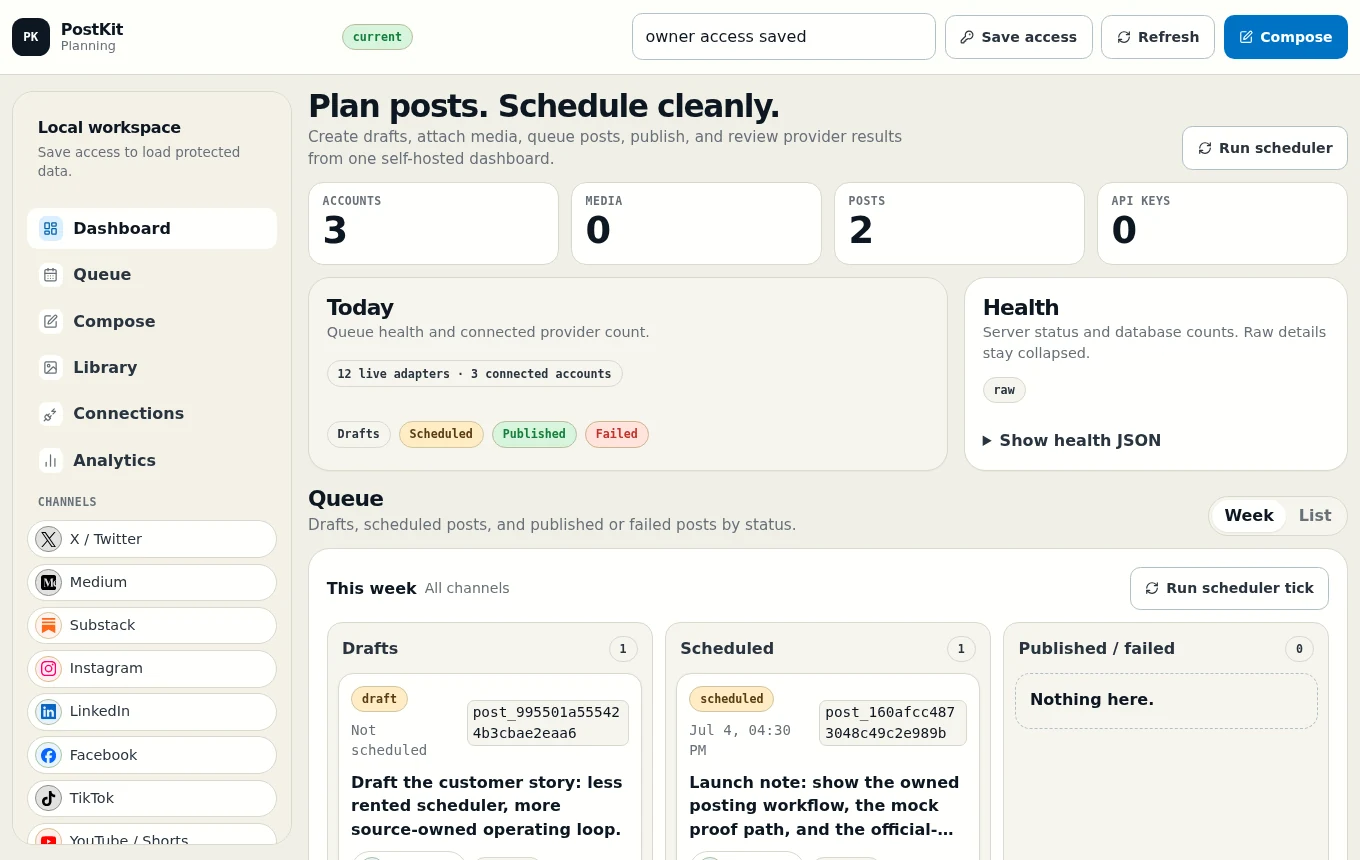
Workbench tour
PostKit is easiest to understand as a loop: prove ownership, build the queue, then connect official platform APIs only when the operator is ready.
01 / Owner setup
Paste the owner token, create API keys for automations, and keep the workflow under your own account instead of another rented scheduler.
02 / Compose and queue
Upload media, choose accounts, create platform-specific versions, schedule posts, publish in mock mode, and inspect target-level results before any live credential work.
03 / Provider boundary
PostKit records missing scopes, credentials, quotas, and app-review blockers instead of pretending a post went live.
What it replaces
Social posting is repetitive, operational, and easy to rent forever. A business needs captions, media, accounts, schedules, retries, provider errors, analytics, and handoff notes. That is a system. If the system matters, owning the source makes it easier to inspect, automate, back up, and adapt.
How it works
PostKit lets you learn and verify the workflow before real platform credentials enter the picture.
Start from the KapKit-approved PostKit source package when the launch gate opens.
Install the Bun + SQLite app, set owner secrets, and open the local dashboard.
Create mock accounts, upload media, draft posts, schedule them, publish in mock mode, retry failures, and sync analytics records.
Add buyer-owned developer app credentials, OAuth callbacks, scopes, quota access, account eligibility, and platform review evidence where required.
Run the scheduler tick from cron or systemd, inspect provider results, retry failed targets, and automate through API keys.
Platform support posture
PostKit does not scrape passwords, bypass platform rules, hide rate limits, or pretend a post went live. If a provider is missing credentials or approval, it fails closed and records the setup problem.
Readiness 1
Prove the posting workflow without touching a real social account.
Readiness 2
Official-API adapter paths can be implemented and tested with mocked HTTP against documented request shapes.
Readiness 3
The self-host owner supplies official developer apps, callback URLs, credentials, scopes, quota access, account eligibility, and review evidence.
Readiness 4
If a platform has no official publishing API, PostKit can model it and explain the blocker without unofficial APIs, cookies, scraping, or browser automation.
Product depth
Owning the workflow means owning the parts that make it operable: source, database, media, credentials, scheduler, results, and the API your operator or AI assistant can use.
Self-hosted UI for owner token setup, account management, compose, queue, results, and analytics.
Bun server and SQLite schema for local-first ownership.
Local media storage so assets stay near the scheduler.
REST API for accounts, media, posts, targets, categories, queues, scheduler ticks, results, analytics, and API keys.
Mock provider for safe local proof before real platform credentials enter the flow.
Official-API adapter code for the target platform inventory, including X and Medium where official publishing APIs are available.
Fail-closed Substack posture because Substack's official Developer API does not expose newsletter post publishing.
Fail-closed provider behavior when credentials, scopes, media rules, or app approval are missing.
Platform credential docs, provider-readiness docs, smoke tests, and validation tests.
Good fit
Not the promise
Current launch boundary
PostKit checkout, source-access delivery, and customer repo invites stay behind explicit launch gates. No production platform credentials are shipped by KapKit. No live third-party publishing verification is claimed from this page. No unofficial Substack private API, browser-cookie, scraping, or browser-automation publishing path is claimed or planned.
The current CTA is manual intake so KapKit can confirm fit, access timing, provider readiness, and the right next step.
FAQ
For owned drafting, scheduling, media upload, platform-specific versions, API automation, result tracking, retries, categories, and self-host control, yes. For live posting, every platform still requires official credentials, scopes, eligibility, and app-review boundaries.
No. PostKit is a self-hosted source package. You run it, own the database, store the media, protect the credentials, and operate the scheduler.
No. The product direction is buyer-owned credentials in the self-hosted installation. Secrets stay in the owner's environment, password manager, or protected PostKit connection flow.
Yes. The REST API and API keys are built so an operator or agent can create drafts, upload media, schedule posts, run publish ticks, inspect results, retry failures, and sync analytics.
The local product workflow can be proved with mock provider tests, source tests, and guarded provider setup flows. Live third-party posting depends on real platform credentials, scopes, account eligibility, quota access, and platform review.
Stop renting the posting workflow
If your business already depends on a rented social scheduler, PostKit gives you the owned alternative: one dashboard, one API, one server, and clear official-provider boundaries.